CHICKS
- 1st chick: 27 days old (hatched on 14.06)
EGGS unhatched (laid on 13.05 at 22:22 and 16.05 at 02:05)
Stork chicks grow exponentially. 90 days in the nest is like 18-21 years for humans. This means that 1 day in the nest is like almost 3 months for a human child. That is why their transformation is so amazing and fast.
youtube chat info - thx to everyone
English translation only from now on – assisted by Gemini
YouTube comments do not reflect all nest events throughout the day, including chick feedings; therefore, the log is unfortunately incomplete.
Nest Activity Log 11/07/2026
07:33 Female Kerli arrives at the nest after a prolonged absence; regurgitates food (including some fish) in three separate portions (at 12:52:03, 12:52:05, and 12:54:05). The first portion appears to be a water shrew (Neomys fodiens) or alternative small rodent. The final portion is pulled directly from her bill by the storklet. (by me)
07:33:59 Female departs from the nest branch with a slightly unstable/clumsy take-off. (@pajapapaja)
13:41 Male Kergu arrives; regurgitates a significant quantity of fish.
13:44 Male departs from the nest.
17:52 Storklet stands up and executes a slice over the nest edge (poop-shot).
17:57 Male Kergu arrives for a brief feeding; regurgitates food.
17:59 Male departs from the nest prior to the onset of the severe convective storm system.
20:42 Storklet exhibits displacement behavior, manipulating a single leaf with its bill, followed by low-intensity wing-exercising routines.
20:54 Storklet executes another slice over the nest edge.
Weather and Environment
10:59 Community observations note an unseasonably high volume of cumulative monthly precipitation for July within the region, resulting in elevated water levels in local creeks and rivers, which correlates with an increased proportion of amphibians (frogs) in black stork diets across regional nests.
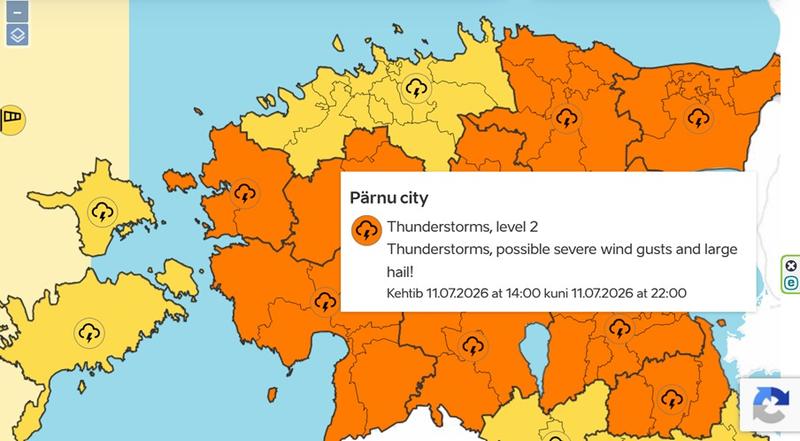
17:10 A rapid and severe weather transition occurs. A Level 2 meteorological warning is active for the Pärnu region due to a massive convective cell producing heavy rainfall, strong wind gusts, and localized large hail.
18:30 - 19:30 The core of the thunderstorm system moves directly through the nesting area. High-velocity winds and intense rainfall cause severe nesting conditions. The 27-day-old storklet vocalises for parental shelter and maintains a sitting (anatomically kneeling) position on the nest floor throughout the entire storm, as this posture facilitates optimal water run-off across its plumage and minimises direct exposure compared to a lying position.
19:12 The heaviest core of the convective storm cluster passes slightly north of the nesting site, preventing severe damage to the chick. The loose structure of the black stork nest prevents water logging, allowing effective drainage.
19:29 Wind velocity and precipitation drop significantly, though damp and unsettled conditions persist over the nesting area.
Summary of Community and Technical Discussion
Parental Instincts and Adult Survival
A debate regarding whether the male enticed the female back to the nest was clarified: the female's return after a prolonged absence is driven strictly by individual parental instinct rather than partner coordination. Observers noted that the female appeared fatigued or out of condition, likely due to low foraging success. It was emphasised that under severe environmental stress, adult survival biologically supersedes chick investment. (by me)
Biological Clock and Migration Patterns
Data confirms that the male parent, Kergu, possesses a rigid internal biological clock, consistently initiating autumn migration around mid-August regardless of the developmental stage of the brood (as observed in the previous season). Given the late nesting timeline of this season, it is highly improbable that the male will delay his departure to accommodate this late-hatched chick. (by me)
Brood Security and Potential Interventions
At 27 days of age, black storklets are no longer provided constant parental brooding or protection ("mombrella/dadbrella" behavior) during rainfall, as their plumage development provides adequate water resistance under standard conditions; however, extreme elements like hail remain highly dangerous. (by me)
While community members raised questions regarding anthropogenic rescue by experts (e.g., Urmas Sellis), it was clarified that intervention is a highly complex regulatory and biological challenge, only considered as a last resort if absolute parental abandonment is verified. (by me + hulbi)
Misconceptions on Failed Eggs and Predators
In response to concerns about non-viable eggs exploding due to internal gas pressure from ambient heat, it was clarified that failed eggs typically desiccate or mummify as moisture evaporates through shell pores, making explosion highly unlikely. Furthermore, while opportunistic predators like corvids (crows) or mustelids (martens) will investigate and breach failed eggs once the nest is fully vacated in autumn, they generally discard the rotten or dried contents rather than consuming them. (by me)
Kerli jumped on the lookout and flew away at 13:39:12.
yotube info:
12:41 PM@pajapapaja2241
kerli opravdu nemusi byt uplne v kondici,zustala odpocivat pomerne dlouho na hnizde a odlet z vetve nebyl uplne dobry
- Kerli really might not be in top shape; she stayed to rest on the nest for quite a long time, and her take-off from the branch wasn't very good.


 (12:51:40)