Połczyn

Post Reply
marika.solo
Site Admin
Posts: 27445
Joined: 29 Sep 2021, 09:38

Re: Połczyn

Post by marika.solo »

youtube chat info - thx to everyone - wielkie dzięki za Wasze raporty :D
English translation – assisted by Gemini

male Mieszko - female Bawarka

EDIT 12.07.2026
1/
14:32 @MKmatyl dogadałyśmy dziś rano z Izabela że wczoraj (11 lipca) pierwsze karmienie zrobił Mieszko o 6:11:21

10:23:32 food begging behaviour starts
2/ 10:26:04 Bawarka in - regurgitating (fish and frogs?) - 10:26:27 Bawarka out (with one pieces)

10:57:07 food begging behaviour starts
3/ 10:50:13 Mieszko in - feeding (a lot o fish) - 10:50:29 Mieszko out

4/ 13:19 reniaS06​​ 12.59.54 przylot M I karmienie; ​​znowu stos ryb, pięknie opóźnia staw 🤣

5/16:05@EwaSzalacha​​16..03 16. Mieszko - ​nie wiem czy cokolwiek zrzucił,zaraz odleciał
16:16 @wiesia-R​​ 16.03.15 Mieszko, stos ryb, ​16.03.31 odlot M

6/ 18:18 @MKmatylda​​ Bawarka 18:16:30 przylot - ​​Odlot Bawarki 18:16:47 - ​​Widziałam rybki. ​​Nie było tego tak dużo jak Mieszko dostarcza ale Bawarka sie dobrze spisuje.

EDIT 12.07.2026
7/
14:35 @MKmatylda ​​Wczoraj 11 lipca Mieszko 18:21:03 przylot i odlot 18:21:22 - mnóstwo rybek !
marika.solo
Site Admin
Posts: 27445
Joined: 29 Sep 2021, 09:38

Re: Połczyn

Post by marika.solo »

who is who on the nest

13.06 - ringing day

Biometrics
VX7910 + 1FT4
Wing = 275 mm; Beak = 93 mm; Leg = 159 mm; Weight = 2400 g
VX7911 + Foot-Mounted Locator
Wing = 284 mm; Beak = 101 mm; Leg = 165 mm; Weight = 2700 g
VX7912 +Foot-Mounted Locator
Wing = 270 mm; Beak = 98 mm; Leg = 158 mm; Weight = 2500 g

29.06
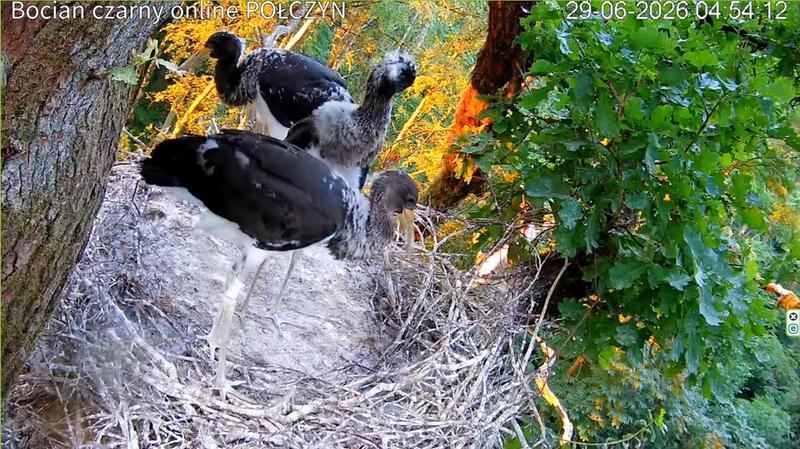
marika.solo wrote: 29 Jun 2026, 08:22 Our trio were likely more or less identical in size across all measured parameters at the time of ringing. It is highly unusual for a transmitter to be fitted to the youngest chick; on the contrary, it is typically only the most developed or eldest chick that receives one. However, judging by appearances (having the least nestling down) and behaviour (such as the most intensive wing training), it seems that the eldest chick on this nest was the one that did not receive a transmitter. Or was that intentional?

Image
continuation:
For VX7910 + 1FT4 and VX7912 + Foot-Mounted Locator, these were minimal differences. Weight probably decided it, rather than wing or leg length. (Females tend to have shorter bills, but at this age, I guess it's not a decisive indicator of sex yet)

VX7910 + 1FT4 i VX7912 + Foot-Mounted Locator – to były minimalne różnice, prawdopodobnie zdecydowała waga, a nie długość skrzydła czy nogi (samice miewają krótsze dzioby, ale w tym wieku nie jest to jeszcze decydujący wskaźnik płci).
marika.solo
Site Admin
Posts: 27445
Joined: 29 Sep 2021, 09:38

Re: Połczyn

Post by marika.solo »

feeding by Bawarka at 10:26 (maybe fish - I saw only two, bad view on the regurgitated food)

Image
marika.solo
Site Admin
Posts: 27445
Joined: 29 Sep 2021, 09:38

Re: Połczyn

Post by marika.solo »

feeding by Mieszko at 10:50, following shortly after Bawarka's

Image
marika.solo
Site Admin
Posts: 27445
Joined: 29 Sep 2021, 09:38

Re: Połczyn

Post by marika.solo »

In the evening, I will upload the photos using a new photohoster (image hosting site). Postimage still doesn't seem to work reliably; the images I uploaded this morning, which were visible earlier today, have gradually disappeared again
marika.solo
Site Admin
Posts: 27445
Joined: 29 Sep 2021, 09:38

Re: Połczyn

Post by marika.solo »

previous day 11.07 viewtopic.php?p=61465#p61465
next day 13.07


July 12
Hello everyone :-)

CHICKS 🐥🐥🐥
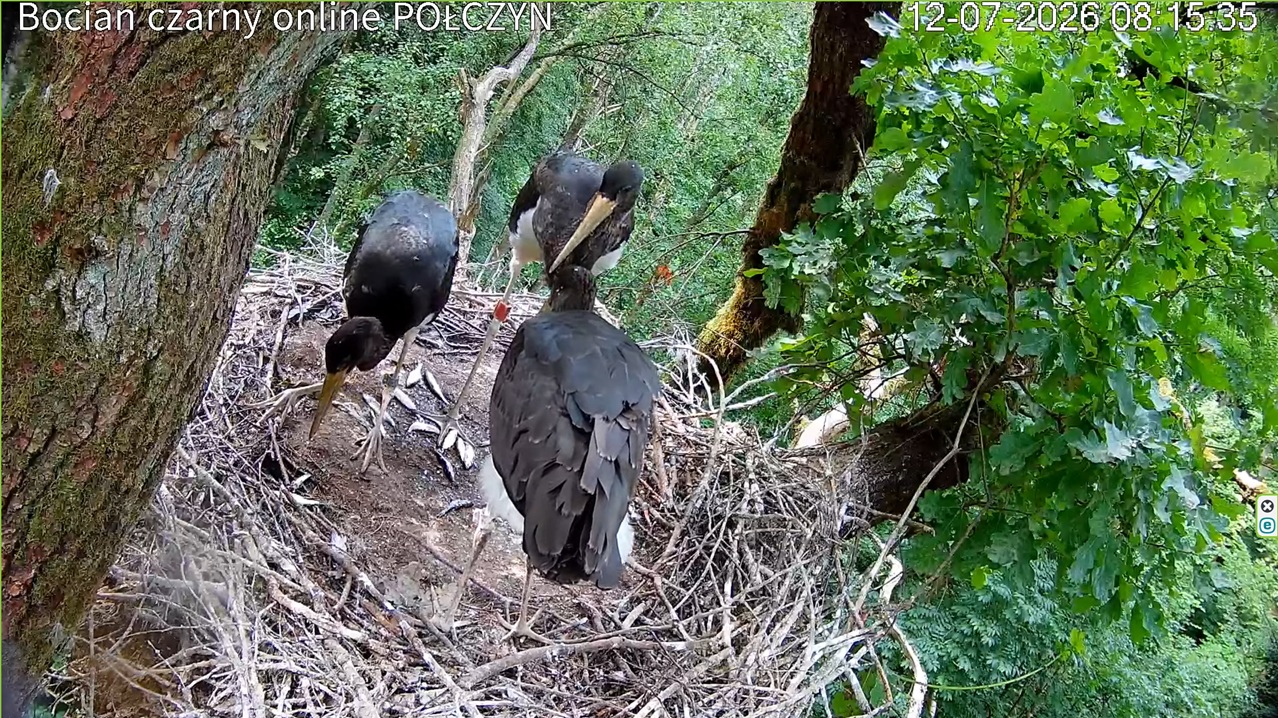
- 1st chick: 63 days old - VX7911 + lokalizator nożny / legtransmitter
- 2nd chick: 63 days old - VX7912 + lokalizator nożny /legtransmitter
- 3rd chick: 62 days old - VX7910 + 1FT4 (readable white colour-ring)

weather:
7:08 @IzabelaHanna​​
- dziś w Połczynie: teraz 17°--> 23°C , od rana 🌤, ☁ zamiennie....do wieczora;
- today in Połczyn: now 17°--> 23°C, from the morning, alternately... until the evening;
marika.solo
Site Admin
Posts: 27445
Joined: 29 Sep 2021, 09:38

Re: Połczyn

Post by marika.solo »

youtube chat info - thx to everyone - wielkie dzięki za Wasze raporty :D
English translation – assisted by Gemini

male Mieszko - female Bawarka

05:33:25 begging display begins
1/ 05:33:37 Mieszko in - feeding (a lot o fish) - 05:33:51 Mieszko out
(6:11 @IzabelaHanna ​​5.33.37. przylot Mieszka - ​​5.33.51 karmienie, mnóstwo rybek, odlot)

07:30:17 food begging behaviour starts
2/ 07:35:43 Bawarka in - regurgitating (a lot of fish) - 07:36:09 Bawarka out
7:38 @IzabelaHanna​​ 7.35.43. spokojnie wesxla do gniazda, karmienie, rybki; 7:39 @MKmatylda​ ​Bawarka 7:36:09 odlot - ​Ona przyniosła tyle rybek że Mieszko by się nie powstydził

08:07:51 begging display begins
3/ 08:08:03 Mieszko in - feeding (a lot o fish) - 08:08:22 Mieszko out
11:49 @PtakiBirds ​​8.08.03 Przylot Mieszka, 8.08.17 Karmienie M, 8.08.22 Odlot M

13:41:54 begging display begins
4/ 13:42:08 Mieszko in - feeding (a lot o fish) - 13:42:26 Mieszko out
@wiesia-R​​ 13.42.08 Mieszko i karmienie stosem ryb - ​13.42.26 odlot Mieszko

16:43:10 begging display begins
5/ 16:43:24 Mieszko in - feeding (lot of fish) - 16:43:46 Mieszko out

18:01:21 food begging behaviour starts
6/ 18:05:07 Bawarka in - regurgitating (a lot of fish) - 18:05:33 Bawarka out
18:06 @wiesia-R​​ 18.05.07 Bawarka - ​​Karmienie , mnóstwo ryb, że nie do wiary - ​​18.05.33 odlot Bawarki - ​​Mama się podzieliła rybami, a młode zostawiły też na drugą kolację

18:35:37 begging display begins
7/ 18:36:12 Mieszko in - feeding (lot of fish) - 18:36:8 Mieszko out
18:36 @wiesia-R ​​18.36.12 Mieszko - Całe gniazdo w rybach - 18.36.38 odlot Mieszka
marika.solo
Site Admin
Posts: 27445
Joined: 29 Sep 2021, 09:38

Re: Połczyn

Post by marika.solo »

Timeline of Events

03:40 – All three chicks are observed standing on their feet.

05:33:37 – The adult male Mieszko arrives at the nest and regurgitates a large quantity of fish, then flies away at 05:33:51.

07:25 – The chicks begin vigorous wing exercises, which continue through 07:30.
07:30 – The chicks begin loud vocalizations, signaling an approaching parent.

07:35:43 – The adult female Bawarka lands calmly in the nest and drops a significant quantity of fish for the chicks.
07:36:09 – The adult female Bawarka departs the nest.

09:14 – The nest area is fully exposed to direct sunlight; the chicks remain in the nest.

08:08:03 – The adult male Mieszko arrives at the nest and regurgitates a portion of fish for the chicks at 08:08:17, before departing the nest at 08:08:22.

09:53 – One of the fully feathered chicks interacts with a remaining fish left in the nest crown from the earlier plentiful feeding, eventually consuming it.
10:13 – Leftover fish items remain uneaten on the nest floor, indicating temporary satiation.
11:08 – Unconsumed fish items are still visible on the nest floor as the chicks choose to leave the food for later.
12:06:48 – The chicks begin defensive chirping and vocalisations due to an unidentified adult stork flying near the nest area.
12:07:20 – The chicks consume some of the leftover fish from the nest floor, leaving a few items for later.

13:42:08 – The adult male Mieszko arrives and regurgitates a large pile of fish for the chicks, before departing the nest at 13:42:26.

14:24 – Chick Wanda stands with her bill open, regulating her body temperature due to ambient heat.
15:31 – All three chicks stand alert and look intently in the same direction, tracking movement outside the nest.
16:29 – The chicks exhibit intense restlessness and preparation for flight, flapping their wings vigorously.

18:05:07 – The adult female Bawarka arrives and regurgitates a large quantity of fish; the chicks selectively consume a portion of the prey, leaving a considerable amount of fish uneaten on the nest floor before she departs at 18:05:33.

18:36:12 – The adult male Mieszko arrives and drops an additional massive pile of fish directly onto the nest, further accumulating the unconsumed food supply before flying away at 18:36:38.

19:22 – One chick engages in intense wing and branching exercises, specifically grasping and manipulating a nearby oak branch while maintaining stability on the nest edge.
19:26:54 – The chicks engage in a brief tug-of-war interaction over a stick on the nest floor, completely ignoring the abundant food heap around them.
19:33 – One chick actively manipulates and pecks at moss growing on the surrounding branches.

16:43:24 – The adult male Mieszko returns and drops a massive quantity of fresh fish into the nest, then flies away at 16:43:46.

17:54 – A black woodpecker (Dryocopus martius) vocalization is heard nearby; a butterfly passes directly in front of the camera lens.

18:05:07 – The adult female Bawarka arrives at the nest.

20:08 – The chicks utilize the abundance of uneaten fish to practice their bill-gripping coordination, picking up and manipulating the prey without swallowing.
20:41 – The black stork chicks are observed resting directly on top of the massive heap of uneaten fish scattered across the nest floor.
20:44 – Due to the food pile occupying the central area of the nest floor, the three chicks distribute themselves along the outer corners of the nest perimeter to rest.

Discussions

Foraging and Feeding Habits: Chat members debated parental foraging patterns, theorising that the adult female Bawarka had successfully changed her foraging grounds from her usual amphibian sources to rich fish sources, bringing an exceptional abundance of fish today.

Nest Infrastructure & Camera Angles: Viewers expressed a desire for a wider camera angle to evaluate the surrounding branches for upcoming branching exercises. References were made to the official ringing video from June 13th to analyse the nest tree morphology.

Avian Energetics and Growth Stages: Experienced forum moderation (me) corrected misconceptions regarding the chicks' heavy food rejection and remaining fish. It was explained that since the chicks are now fully feathered, their primary structural growth phase has stabilised, which temporarily decreases their overall basal metabolic energy requirements. Consequently, they do not require the same massive daily volume of biomass as during peak skeletal and feather development. Additionally, it was clarified that even when the post-fledging flight phase begins, initial flights are highly localised, typically covering short distances between 200 to 500 meters from the nest tree, which does not immediately cause a massive surge in caloric demand.

Intraspecific and Local Fauna Presence: Observers noted that the defensive reaction of the chicks at 12:06:48 was likely triggered by a non-breeding floater passing close to the nest canopy. Later in the afternoon, the distinct calls of a local black woodpecker (Dryocopus martius) were identified near the nest tree.

Feeding Statistics and Verification: A collaborative effort among chat members successfully confirmed the exact feeding timeline for the day. It was verified that the parent storks provided a total of 5 successful deliveries by late afternoon (Mieszko at 05:33, 08:08, 13:42, and 16:43; Bawarka at 07:35). Clarifications were made regarding a chronological mix-up in chat observations, confirming that Mieszko's 08:08 delivery occurred after Bawarka's morning visit.

Data Retrieval and Chat Volume: The moderation (me) noted that due to high chat traffic and casual conversations, official logging data can easily be displaced on the system. Past data from July 11th was retroactively recovered and corrected through collaborative verification, confirming two missing feeding sequences by Mieszko on that day (a morning delivery at 06:11:21 and an evening delivery of fish between 18:21:03 and 18:21:22).

Prey Abundance and Satiation: A significant part of the evening conversation focused on the unprecedented surplus of food delivered by both parents. With 7 successful feedings recorded today (Mieszko delivering 5 times, Bawarka 2 times), the chicks reached complete satiation. The final two consecutive deliveries (Bawarka at 18:05 and Mieszko at 18:36) resulted in a large heap of fish covering the nest floor. Viewers light-heartedly remarked on the birds being so overfed that they completely ignored the fresh fish, choosing instead to play with sticks, pull at moss, and exercise on branches.

Foraging Speculation: Observers jokingly speculated on Mieszko's highly efficient foraging site, suggesting he might be utilising local commercial fish-ponds or breeding facilities given the massive volume of small fish brought in a single day.

Cross-Nest Comparisons: Noting the extreme abundance of biomass in the Połczyn nest, chat members humorously compared it to other monitored sites experiencing lower food security (such as the Tajo/La Cantera nest in Spain or the Bolewice nest), jokingly suggesting sending the excess fish package to them.

Avian Behaviour and Training: The chat moderation (me) pointed out that the presence of surplus food serves a practical purpose for the fully feathered chicks. Instead of ignoring it entirely, they utilise the static prey items on the nest floor to fine-tune their hunting mechanics, practising essential bill-gripping and prey-handling techniques necessary for post-fledging survival.

Environmental Degradation of Biomass: Chat members discussed the preservation of the uneaten fish heap. While some expressed concern regarding the quick spoilage of fish tissue starting from the head, others noted that the moderate ambient temperatures of the day would sufficiently slow bacterial decomposition, keeping the food viable for the next morning.

Cross-Nest Logistics and Community Welcomes: The extreme contrast in food abundance prompted conversations with a newly arrived community member (Małgorzata-k1l) from the Dąb3 nest, where food provisions were critically low that Sunday. The chat humorously lamented the impossibility of teleporting Połczyn's multi-kilogram surplus to struggling nests like Dąb3 or Bolewice.

Summary of Camera & Ringing Theories: As promised, here is the synthesis of the earlier conceptual discussions from today's logs:
Camera and Nest Infrastructure: Viewers closely analysed the physical layout of the nest tree to gauge the chicks' safety during upcoming branching exercises. Due to the limited view provided by the primary camera stream, users tracked down and shared the official June 13th chick-ringing video. The community used this wider perspective footage to verify the distribution of nearby oak branches, concluding that the chicks have ample structures to leap onto once they begin branching.
The Post-Fledging Dispersion Paradox: Chat participants debated the necessity of localised landmarks for fledging success, referencing past black stork populations (such as the Notecka forest group) that successfully fledged and avoided anthropogenic contact despite structural differences. This supported the moderation's guidance that initial flights remain tightly localised within a 200 to 500-meter radius of the home tree.

Explanations provided by me (Marika.Solo). English translation assisted by Gemini.
marika.solo
Site Admin
Posts: 27445
Joined: 29 Sep 2021, 09:38

Re: Połczyn

Post by marika.solo »

07:34 Bawarka feeding

Image


:mrgreen: (after feeding by Mieszko at 08:08)

Image
marika.solo
Site Admin
Posts: 27445
Joined: 29 Sep 2021, 09:38

Re: Połczyn

Post by marika.solo »

feeding by Mieszko at 16:43, great again

Image
Post Reply

Return to “Poland”