A definitive answer requires the stork to be found as soon as possible and the site and body to be examined by a qualified person, or an autopsy to be carried out. The longer this takes, the more difficult it becomes to determine the cause of death and carry out further tests.
Work in progress.
I have been in contact with a local volunteer who found Lembe and has been helping with the situation today.
She is a volunteer and has been helping with Lembe at the site. She did not initially know his name and wanted to find out which Estonian
stork it was. She said that she has been following Estonian storks via YouTube videos for several years and was very happy to learn that the stork she had found was Lembe.
(other information not public yet - Kotkaklubi knows)
"The transmitter data shows that Lembe and the GPS transmitter have been found and forwarded for research. Perhaps Urmas also has more detailed information now."
to Bălți: a city in Moldova. It is the third-largest city in terms of population, area and economic importance.
a local volunteer who found Lembe and has been helping with the situation wrote to me also this yesterday:
Regarding Lembe:
An X-ray will be carried out to determine whether he definitely died from a gunshot. At present, she estimates this at about 90%, based on a visible hole in his chest.
Four spoonbills have also been killed in the area. She said that the police have opened a criminal investigation and that she hopes the person responsible will be punished.
(btw. She took the photos and videos herself today. / 09.09)
A juvenile whose life was saved by a trail camera when it was still a nestling. Lembe hatched as the third chick in a nest located in northern Latvia — a nest our Latvian colleagues had known about for years. The trail camera transmitted images of nest activity until, at noon on June 8th, the nest was no longer visible in the pictures. Upon inspection at the site, the largest chick was found dead, the second was injured, and the third appeared to be in perfect health. The injured chick later died, but the third one grew up in a foster nest. We fed the two surviving two chicks at a farm, trying to avoid habituating them to humans.
Once the adult bird at the nearest nest stopped guarding its own chicks, we added the foster chick to the brood of three local chicks in a nest within Karula National Park (on July 18th). We nicknamed him "Parachutist." The local chicks were a few days older, so Parachutist was the last to fledge (on August 1st). However, all of them—including the foster chick—had plenty of time to hone the skills needed for independent life through their flights in and out of the nest. All the chicks learned to feed at a fish basket placed there for the adult storks to help them better feed their young.
The plan was to monitor the foster chick's progress using a transmitter, but it wasn't possible to fit the device while he was still in the nest—doing so would have caused his older foster siblings to fledge prematurely. Consequently, we captured the foster chick at the fish basket on August 19th and named him LEMBE. However, after being captured and fitted with a transmitter, the young bird Lembe immediately set off on migration (along with two other juveniles that could not be tracked).
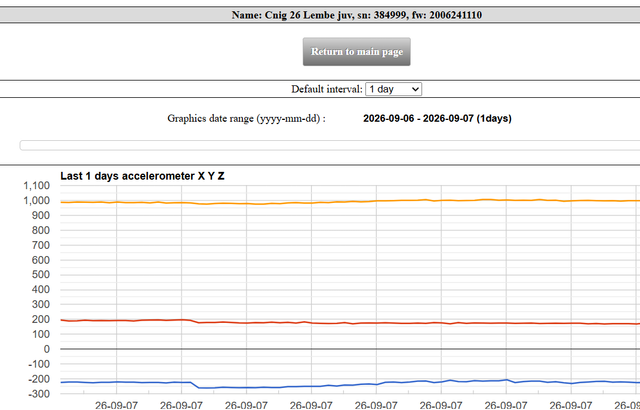
Around 8:30 PM on September 6, Lembe’s transmitter stopped moving in northern Moldova, on the shore of a pond. Based on the transmitter's location, illegal shooting was suspected. Volunteers from the Moldovan Society for the Protection of Birds and Nature (Societatea pentru Protectia Pasarilor si a Naturii - SPPN), found Lembe’s remains at the site, reinforcing the suspicion of illegal shooting. Several Eurasian spoonbill carcasses were lying nearby, also bearing signs of having been shot.The stork carcass was taken to a veterinarian for examination.